The short version
Three things to keep in mind.
- 01
Make supervision an active adult job.
- 02
Keep meals and quiet places undisturbed.
- 03
Use short activities with a clear stopping point.
What to remember
Your useful takeaways.
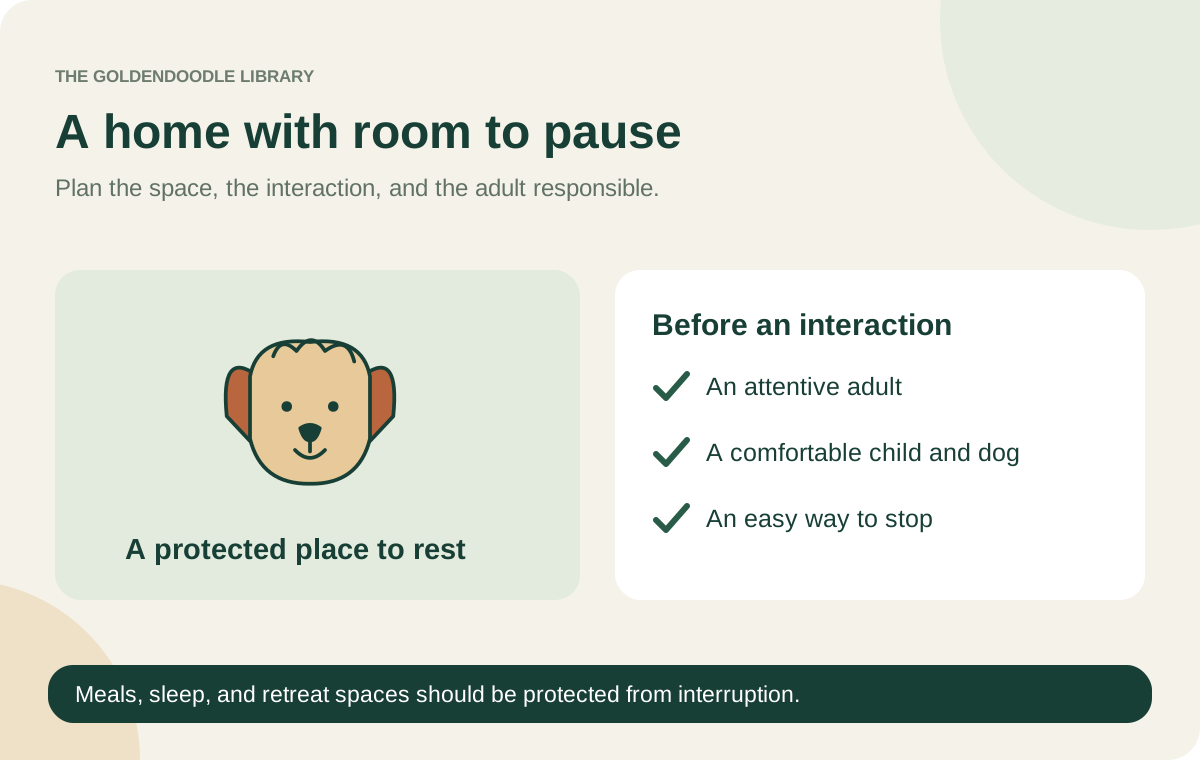
- An attentive adult manages interactions and steps in early.
- Protect meals, rest, and retreat spaces from interruption.
- Use short, simple activities suited to the child and dog.
- Seek professional help for fear, guarding, or concerning behavior.
A little more detail
Explore the questions that matter to you.
Open a section when you want the why behind the short answer.
01Make supervision an active job
AVMA advises supervising young children around dogs and not leaving a baby or small child alone with a dog. Supervision is more useful when an adult can watch and intervene, rather than merely being somewhere in the house. Teach children to ask before greeting an unfamiliar dog and to approach calmly when permission is given.
Create a household handover rule. If the supervising adult must answer the door, cook, or attend to another child, calmly separate the puppy and child into their prepared areas first. This makes safety a practical routine instead of relying on everyone remembering to be careful during an already busy moment.
References: [1]
02Give the dog a place where interaction stops
VCA’s family guidance emphasizes preparation and predictable routines around children and pets. Arrange a resting area the child cannot enter or reach into. Use physical management such as appropriate gates when needed, and teach that a dog resting, eating, or moving away is not an invitation to follow and continue petting.
Choose a few rules caregivers can apply consistently: no climbing on the dog, no pulling the coat, and no taking items from the dog’s mouth. If an item must be recovered, an adult handles the situation. Ask a qualified professional to help with a plan if the dog becomes worried around food, objects, touch, or a particular family activity.
References: [2]
04Adapt the plan to the people in the home
Write instructions in a form your household can use: pictures, simple words, a predictable sequence, or a shared checklist. The support a child needs to follow a routine may differ from what another child needs. Do not assume a diagnosis or an age tells you how a particular child and dog should interact.
Keep a record of situations that are comfortable and situations that are difficult. Share specific examples with your veterinary team or behavior professional. If a dog shows fear, guarding, growling, snapping, or other concerning behavior, separate safely and seek help. A supportive relationship is built through good management and individual attention, not through testing what the dog will tolerate.
Sources & further reading
References supporting this guide; inclusion does not imply endorsement of our program.
For an individual dog’s health or behavior, consult your veterinarian or qualified trainer. For access or funding questions, check current official guidance.
A personal next step
Talk it through with Blaine.
Ask about a planned pairing, puppy matching, or preparing for home.