
The short version
Three things to keep in mind.
- 01
Confirm life stage and expected-size suitability.
- 02
Count food and training rewards together.
- 03
Review growth and portions with your vet.
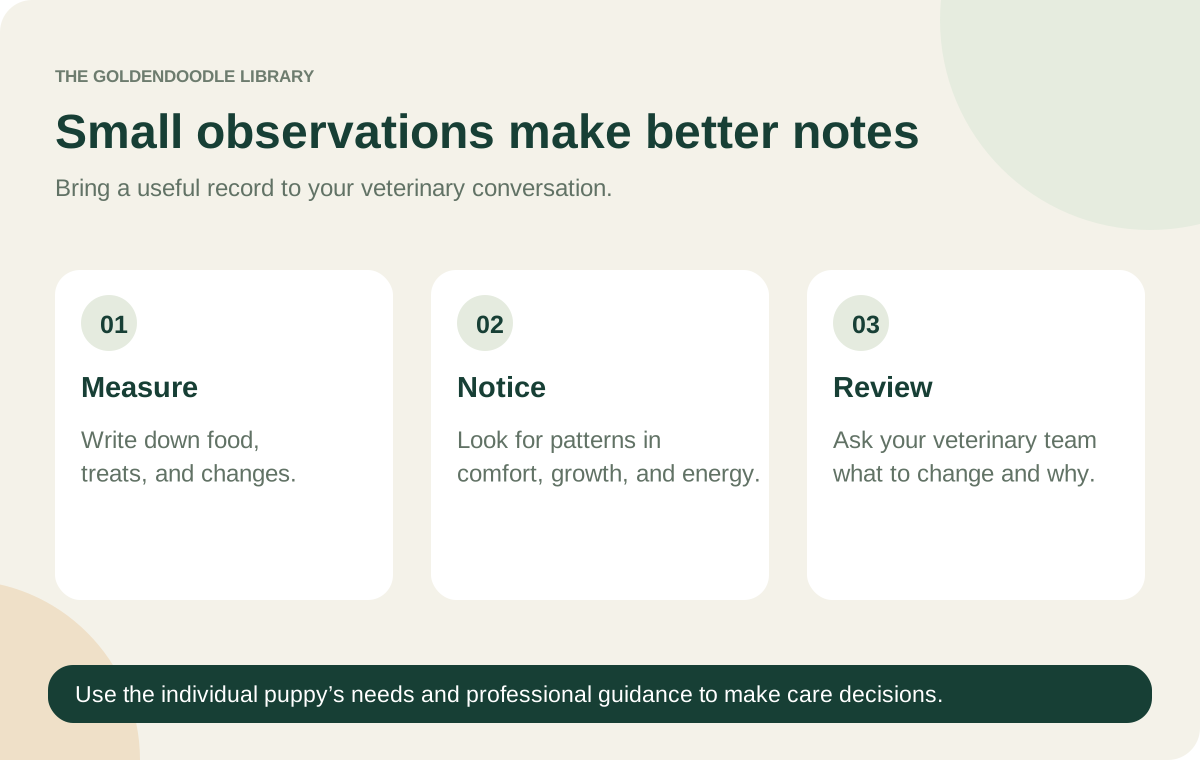
What to remember
Your useful takeaways.
- Choose food intended for the puppy’s life stage and expected size.
- Measure all food and count training rewards in the daily plan.
- Use veterinary growth and body-condition checks to adjust portions.
- Evaluate nutritional expertise and quality control rather than marketing language.
A little more detail
Explore the questions that matter to you.
Open a section when you want the why behind the short answer.
01Ask what the food is designed to do
WSAVA’s food-selection guidance encourages questions about nutritional expertise, formulation, quality control, and accessible manufacturer information. Attractive packaging and terms such as premium do not establish whether a food meets an individual puppy’s needs. Ask your veterinary team how to read the nutritional adequacy statement and obtain calorie information.
Keep a photograph of the label and record the exact product, because similar names can refer to different life-stage formulas. If you change products, discuss an appropriate transition with your veterinary team rather than assuming all foods can be swapped without a plan. Avoid choosing a diet solely from a social-media endorsement or an ingredient that sounds appealing.
References: [1]
02Consider expected size and growth, not just age
AAHA emphasizes nutrition appropriate to life stage and size, with particular attention to controlled growth and lean body condition in larger puppies. A miniature and a standard-sized Goldendoodle should not automatically share the same feeding plan. Ask how the parents’ size and the puppy’s growth pattern influence your veterinarian’s recommendation.
Do not add calcium or other growth supplements simply because a puppy is getting bigger. Discuss supplements, homemade meals, and special diets before making them part of routine feeding. A complete growth diet and an individualized assessment are a more reliable starting point than trying to speed growth or achieve a target weight from an advertisement.
References: [2]
03Make a household food ledger
For one ordinary week, record the amount offered at each meal, what is left, training rewards, chews, and extras from other family members. The purpose is to find the total, not to make food preparation complicated. Assign one person to update the daily plan so a generous family does not accidentally feed the same meal twice.
For example, put the planned training allocation in a separate container each morning and note any additional food used. Take the ledger to your appointment along with the food label. The veterinary team can then advise on the overall pattern and whether the portion, food, reward strategy, or growth-monitoring schedule needs adjustment.
| Daily food record | Details to bring to the vet |
|---|---|
| Main food | Exact product, calorie information, measured amount |
| Training rewards | Type and total quantity offered |
| Extras | Chews, leftovers, supplements, other family contributions |
| Observations | Appetite, leftovers, digestive or growth questions |
04Learn what body condition means for this dog
WSAVA provides body-condition tools to support nutritional assessment. Coat fluff and the number on a scale alone do not tell the whole story. Ask your veterinary team to demonstrate how they assess your dog and how you can monitor changes between visits without guessing from photographs of other Goldendoodles.
Keep weights and observations in the same place, and bring appetite or digestive changes to your veterinarian’s attention. Review the plan as the puppy grows rather than treating the initial portion as permanent. Nutrition advice should help you care for the individual in front of you; it should not promise a particular adult size, coat, or service-dog outcome.
References: [3]
Sources & further reading
References supporting this guide; inclusion does not imply endorsement of our program.
- WSAVA: Guidelines on Selecting Pet Foods ↗
- AAHA: Age-specific and Breed-specific Diets ↗
- WSAVA: Global Nutrition Guidelines and Body Condition Tools ↗
For an individual dog’s health or behavior, consult your veterinarian or qualified trainer. For access or funding questions, check current official guidance.
A personal next step
Talk it through with Blaine.
Ask about a planned pairing, puppy matching, or preparing for home.