
The short version
Three things to keep in mind.
- 01
Describe your household’s real routines.
- 02
Review the pairing, records, and puppy observations.
- 03
Clarify dates, support, and who to contact.
What to remember
Your useful takeaways.
- Describe everyday routines and goals before focusing on color or generation labels.
- Ask for the actual parent pairing, individual health records, and available puppy observations.
- Discuss service-dog suitability and training as an individual planning process.
- Clarify what lifetime support means and who to contact as your dog grows.
A little more detail
Explore the questions that matter to you.
Open a section when you want the why behind the short answer.
01Start with your everyday life
Tell Blaine who will live with the puppy, which adult will manage daily care, and what an ordinary weekday looks like. Include work schedules, school routines, other animals, visitors, and time available for training and rest. These details make the discussion more useful than a general request for a calm puppy.
If a family member has autism, Down syndrome, cerebral palsy, or another support need, describe the routines and practical goals that matter to your household. You can keep the first conversation focused on the information you are comfortable sharing. A diagnosis alone does not describe the tasks, environment, or responsibilities a particular dog would encounter.
02Be specific about the companion you hope for
It helps to separate a loving family companion from an emotional-support role, therapy visiting, or a future task-trained service-dog role. Those paths have different assessment, training, and handling expectations. You do not need every answer on the first call, but it is useful to name the questions you are exploring.
For a service-dog prospect, discuss the practical job you have in mind and the professional training support you can access. Ask how the puppy’s development would be assessed over time and what a sensible alternative would look like if the dog were happier or better suited to life as a companion. Breeding purpose is a starting point for this discussion, not an assurance of a finished working dog.
References: [2]
03Ask about the actual pairing, not just the label
The pedigree conversation should identify the proposed mother and father, their background, and the information available about their health and temperament. Ask how the pairing relates to the breeder’s goals and what is known about similar relatives or previous offspring. Specific records are more informative than an impressive-sounding generation abbreviation.
The current program describes service-line ancestry and health-focused selection. Ask to see the supporting information for the individual parents you are considering. A website description or a general promise about a bloodline is not a substitute for the actual record. If a litter has not been announced, treat dates, puppy counts, and likely availability as questions until Blaine confirms them.
- Who are the parents, and what are their generation and ancestry details?
- Which health examinations and genetic tests were completed, and can the results be reviewed?
- What is known about the parents’ everyday behavior and relevant family history?
- Which dates and availability details are confirmed, and which are still estimates?
04Discuss the individual puppy as it develops
San Diego Goldendoodle’s program describes family raising, early socialization, neural stimulation, and temperament testing around seven weeks. Ask what observations are available for the puppy, how the puppy responds in different situations, and how those observations inform matching.
A single assessment or a short visit is one piece of information. Ask what has been seen repeatedly across ordinary handling, rest, novelty, play, and recovery after excitement. A thoughtful discussion should also leave room for development, training, and the adjustment to a new household.
05Make the support conversation concrete
The program’s lifetime-support commitment means the relationship is intended to continue after homecoming. Ask how to reach the team, what puppy information will go home with you, and which questions are best brought to Blaine, a veterinarian, or a qualified trainer.
Before making a commitment, also clarify any written health terms, payment or reservation arrangements, training expectations, and what happens if your circumstances change. Keep the written information together so that everyone is working from the same understanding. A friendly conversation and clear documentation complement one another.
06A simple note to prepare before your first call
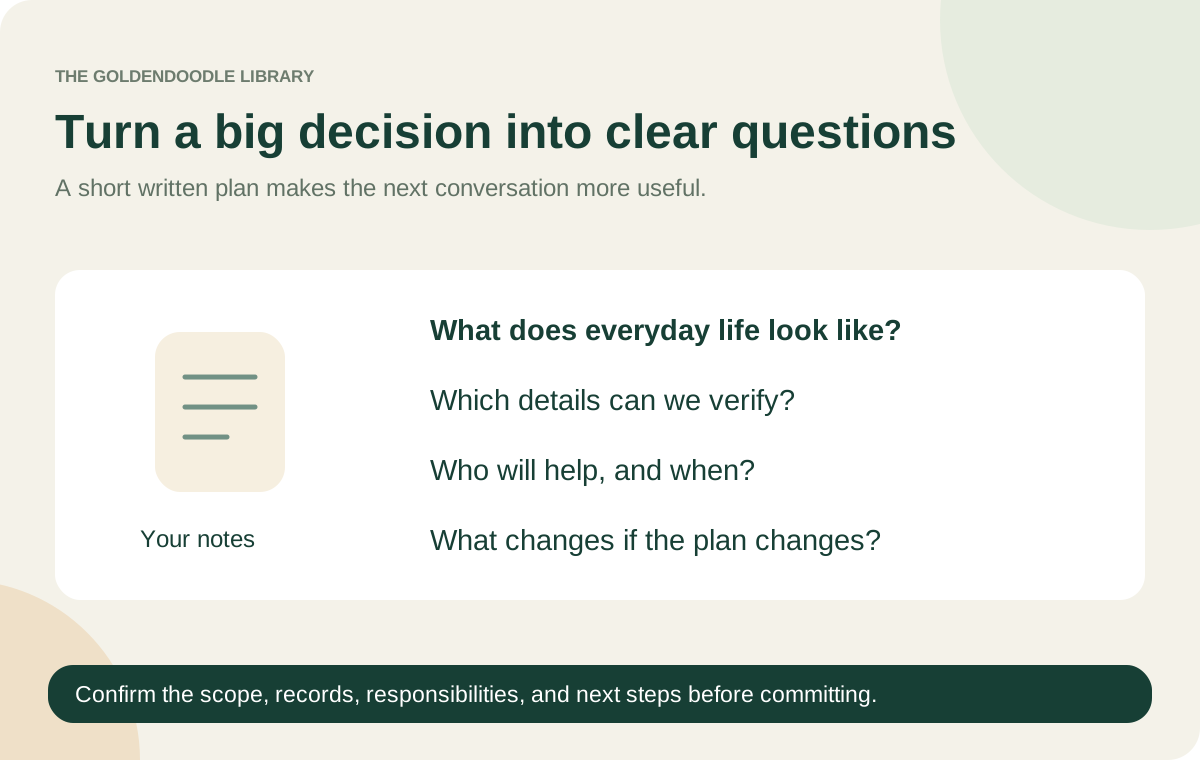
Write down three things: the daily life your dog would join, the role you hope the dog could fill, and your realistic timing. Add your main questions about parents, health records, matching, and support. That short outline gives the first conversation a useful direction without turning it into a test you have to pass.
Call or text Blaine at (760) 708-6409 to discuss the current situation. The website’s puppy and litter pages are a starting point; confirm the specific pairing and availability directly before making plans.
References: [3]
Sources & further reading
References supporting this guide; inclusion does not imply endorsement of our program.
- San Diego Goldendoodle — original family story and breeding philosophy ↗
- San Diego Goldendoodle — original service-line program description ↗
- San Diego Goldendoodle — original application and contact process ↗
For an individual dog’s health or behavior, consult your veterinarian or qualified trainer. For access or funding questions, check current official guidance.
A personal next step
Talk it through with Blaine.
Ask about a planned pairing, puppy matching, or preparing for home.