The short version
Three things to keep in mind.
- 01
Confirm the exact parents of this litter.
- 02
Keep ancestry, health, and training records separate.
- 03
Ask what the relatives add to the picture.
What to remember
Your useful takeaways.
- Confirm that records refer to the exact parents of the litter.
- Separate ancestry records from health results and training credentials.
- Adult relatives can add context to an individual parent’s history.
- Use pedigree information to ask questions, not to predict a guaranteed outcome.
A little more detail
Explore the questions that matter to you.
Open a section when you want the why behind the short answer.
01Start with identity, not impressive names
Ask for the parents’ full identifying names and the way their records are connected to those identities. A call name used at home may differ from a name on a health database or laboratory result. If you cannot tell whether two documents refer to the same dog, ask for the connection to be explained.
Create a simple record sheet with separate spaces for each parent: name, date of birth if provided, pedigree reference, health-report references, and the questions you still have. Keeping the two parents separate prevents a common misunderstanding in which one dog’s strong documentation is assumed to cover both sides of a pairing.
02Read outward to relatives
The Golden Retriever Club of America’s breeder-selection guidance encourages questions about the health and temperament of parents and close relatives. That is a useful reminder that one photograph or one good result does not describe an entire family.
Ask what is known about adult siblings, earlier offspring, and age-related outcomes. Also ask where information is missing. A blank space can mean records were not available; it should not be filled with an assumption that every relative was healthy or had an ideal temperament. Clear limits make the rest of the information easier to evaluate.
References: [1]
03Keep different documents in different columns
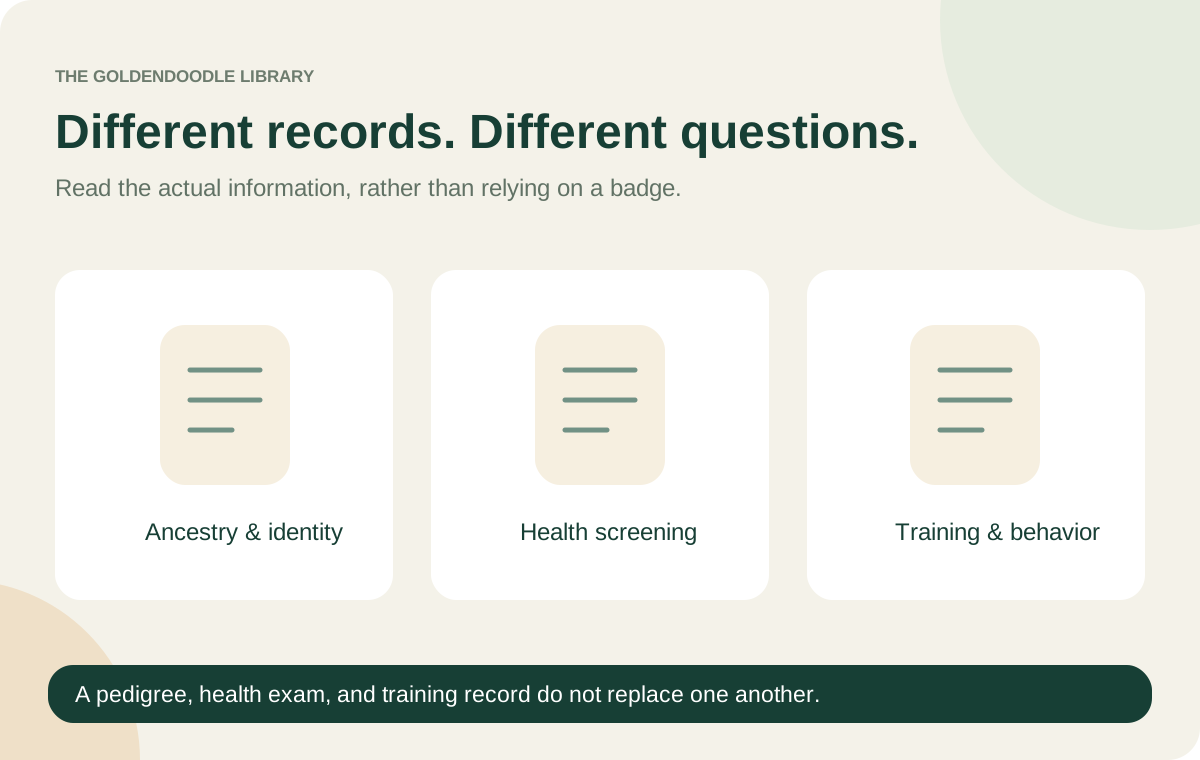
An ancestry record answers who is related to whom. A health report answers a particular screening question. A training record describes work completed by an individual dog with a particular program or handler. None of those documents automatically substitutes for the others.
OFA’s CHIC explanation illustrates why details matter: a CHIC number records completion and public availability of the required screenings, not a promise that every result is normal. Look at the actual tests and results attached to a dog, rather than treating a registration or certificate heading as the conclusion.
References: [2]
04Ask what service-line history means in practice
If a pedigree is described as service-line, ask the breeder to define the term. Which ancestors performed which roles? Were the dogs task-trained service dogs, therapy dogs, emotional support companions, or family pets? What documentation or direct knowledge supports the description?
These questions do not dismiss the value of ancestry. They make the conversation more useful. A breeder may be selecting for qualities they have observed in a family, while the future puppy still requires its own assessment, suitable rearing, and appropriate training. Record what is a breeding goal separately from what an identified ancestor actually did.
05Use the family tree to support a decision
After reviewing the pedigree, write a brief summary in your own words. Name the strengths you understand, the uncertainties that remain, and the records you want to discuss with a veterinarian or qualified training professional. If the summary is still only “many generations of good dogs,” ask for more specific information.
The final decision is still about the puppy and the household. A detailed family tree should help a breeder explain a pairing and support honest expectations. It should never pressure a family to overlook an unsuitable match, unclear health information, or a commitment they cannot comfortably manage.
Sources & further reading
References supporting this guide; inclusion does not imply endorsement of our program.
- Golden Retriever Club of America: Selecting a breeder ↗
- Orthopedic Foundation for Animals: CHIC program ↗
For an individual dog’s health or behavior, consult your veterinarian or qualified trainer. For access or funding questions, check current official guidance.
A personal next step
Talk it through with Blaine.
Ask about a planned pairing, puppy matching, or preparing for home.