The short version
Three things to keep in mind.
- 01
Ask about both sides of the family.
- 02
Look at adult relatives and daily needs.
- 03
Discuss how this puppy will be matched.
What to remember
Your useful takeaways.
- Golden Retriever and Poodle ancestry both deserve attention.
- Breed standards describe breeding ideals, not guarantees for every individual.
- Poodle variety, adult relatives, and the specific pairing matter.
- Match the dog’s actual needs to your household rather than relying on a crossbreed stereotype.
A little more detail
Explore the questions that matter to you.
Open a section when you want the why behind the short answer.
01The Golden Retriever side
The Golden Retriever’s official standard describes an active working retriever with an approachable disposition and a dense, water-resistant coat. That history helps explain why families are drawn to the breed’s connection with people and its working heritage. A standard expresses an ideal; it cannot certify an individual parent or puppy.
For your own planning, turn those broad descriptions into everyday questions. How does the parent behave with unfamiliar visitors? What happens after excitement? Can the dog settle while people are busy? How does the breeder describe the parent’s strengths and the situations that require management? A calm visit is useful, but it is only one moment.
References: [1]
02The Poodle side
The Poodle’s official standard emphasizes an intelligent, active dog. Poodles come in Toy, Miniature, and Standard varieties, with height distinctions defined by the breed’s organizations. A Poodle’s role in a Goldendoodle pedigree therefore needs more explanation than the single word Poodle.
Ask about the actual parent’s adult size, physical comfort, confidence, activity preferences, and ability to relax. Do not assume a smaller Poodle automatically creates a low-effort dog. A household needs to be ready for the individual dog’s exercise, enrichment, handling, training, and coat-care requirements at whatever size that dog reaches.
03A cross is an individual combination
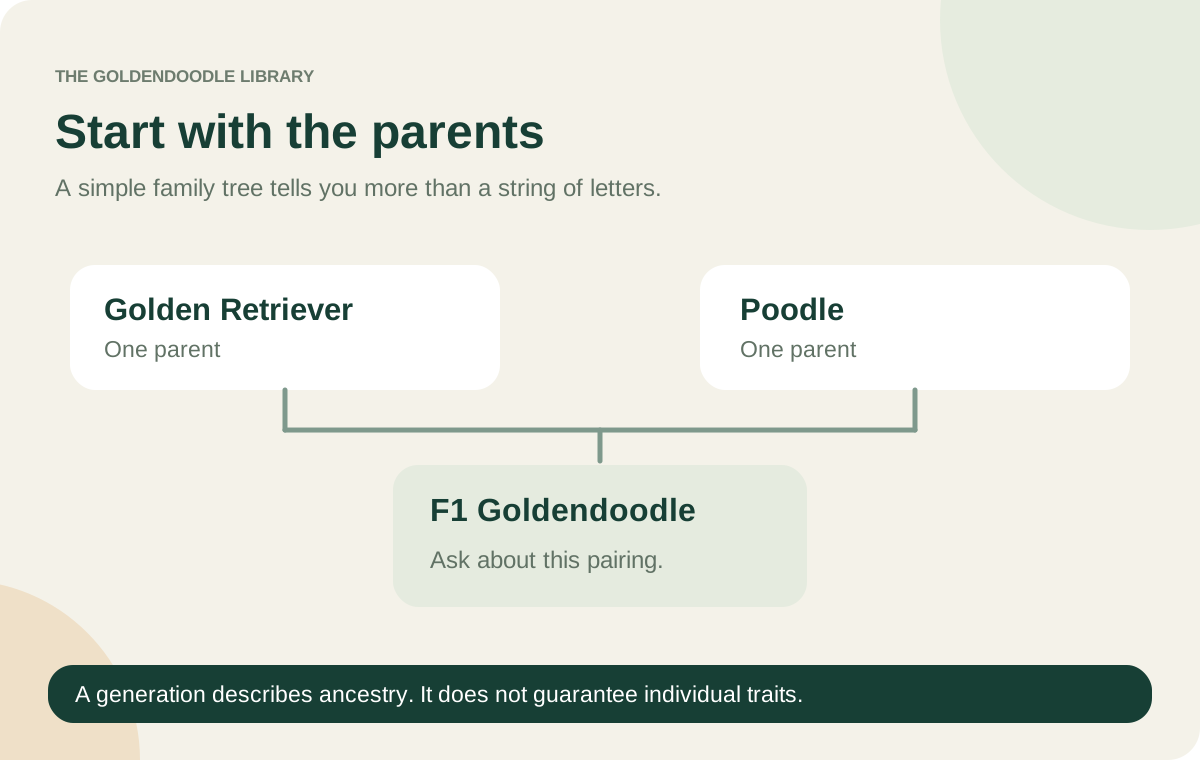
A cross does not reliably split every quality down the middle. You cannot decide in advance that the coat will come from the Poodle and every behavioral preference from the Golden Retriever. Each parent carries a family history, and littermates are individuals even when they share the same parents.
This matters when people use shorthand such as “Golden personality with a Poodle coat.” Treat that phrase as a breeding aspiration to discuss, not a description that has already been proven. Ask what observations, relevant testing, and information from adult relatives support the breeder’s expectations for this specific pairing.
04Translate ancestry into a household plan
Describe a normal weekday before discussing a preferred puppy. Include the length of time adults are away, where the dog will rest, the activity level of children, grooming arrangements, and the situations in which the family hopes to include the dog. These practical details make a matching conversation useful.
If you are interested in future service work, describe the needs and environments involved to an appropriately qualified training professional as well as the breeder. Ancestry can inform a conversation, but a family companion, an emotional support animal, and a task-trained service dog have different roles. The puppy still needs an individual development plan.
05Questions worth taking to the breeder
A helpful answer connects the parents to the puppies and the puppies to your real life. Look for explanations that leave room for uncertainty and describe what support continues after the puppy goes home. You should finish the conversation with a clearer picture, not simply a longer list of appealing breed adjectives.
- Which Poodle variety and which Golden Retriever family are in this pairing?
- What do you know about adult siblings and previous offspring?
- What qualities are you selecting for, and which traits remain uncertain?
- How do you decide which puppy fits a particular household?
- What guidance is available if the puppy’s needs differ from the initial estimate?
Sources & further reading
References supporting this guide; inclusion does not imply endorsement of our program.
- Golden Retriever Club of America: Official breed standard ↗
- Poodle Club of America: Official breed standard ↗
- Poodle Club of America: Sizes of Poodles ↗
For an individual dog’s health or behavior, consult your veterinarian or qualified trainer. For access or funding questions, check current official guidance.
A personal next step
Talk it through with Blaine.
Ask about a planned pairing, puppy matching, or preparing for home.