The short version
Three things to keep in mind.
- 01
Write down the two parents.
- 02
Ask which breed a backcross used.
- 03
Keep trait promises separate from ancestry.
What to remember
Your useful takeaways.
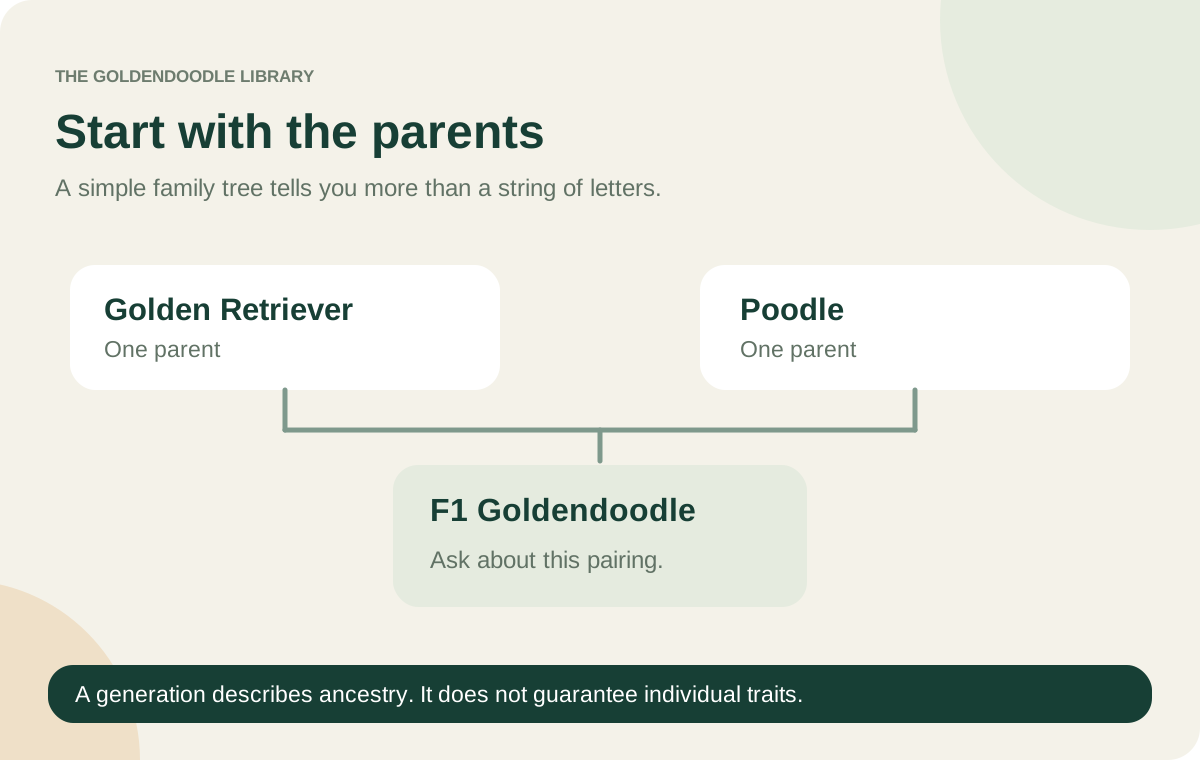
- F1 describes a Golden Retriever–Poodle cross; B indicates a backcross in common usage.
- Ask which original breed was used in a backcross.
- F2B and later-generation labels need the breeder’s exact definition.
- A generation label is not a coat, health, or service-suitability certificate.
A little more detail
Explore the questions that matter to you.
Open a section when you want the why behind the short answer.
01The quick reference
GANA’s terminology describes F1 as Golden Retriever × Poodle, an F1 backcross to either original breed as F1B, and an F1 × F1 cross as F2 in its explanation of filial generations. It favors describing later generations by their actual qualities rather than relying on increasingly complex labels.
| Label | Parentage to confirm | What to ask next |
|---|---|---|
| F1 | Golden Retriever × Poodle | Which size and lines of Poodle? |
| F1B | F1 × an original parent breed | Poodle or Golden Retriever backcross? |
| F1BB | Often an F1B backcrossed again | Exactly which parents and grandparents? |
| F2 | Commonly F1 × F1 | What coat variants do both parents carry? |
| F2B | Used for different later crosses | Write down both parents’ ancestry. |
| Multigenerational | Several generations of Goldendoodle ancestry | What records support the pairing? |
References: [1]
02What the B can and cannot tell you
Think of the B as a prompt to ask another question. Many consumer charts assume the backcross is to a Poodle, but a backcross can be to the Golden Retriever side as well. Those are different family trees. The letters by themselves do not tell you which version a breeder means.
You do not need to memorize every possible cross. Ask the breeder to state the parents in one sentence: for example, an F1 Goldendoodle mother and a Poodle father. That sentence is easier to understand, compare, and keep with the puppy’s records than an unexplained abbreviation.
03A family-tree label is not a trait test
A coat has several features that people often group together: length, curl, facial furnishings, and shedding. UC Davis provides separate information about furnishings, curl, and shedding because these are not interchangeable descriptions. A curly puppy is not automatically a particular generation, and a generation name is not an allergy test.
Likewise, a label cannot tell you whether a puppy will settle beside a wheelchair, cope with a busy school environment, or suit a child who needs a gentle introduction. Those questions need individual observation, appropriate assessment, and a plan for development and training.
04Use the label as the beginning of the conversation
When comparing two litters, put the marketing labels in a separate column from the evidence. In the evidence column, list the parents, health records you can inspect, adult relatives, coat information, rearing practices, and the breeder’s approach to matching. An attractive label cannot fill an empty evidence column.
Before reserving a puppy, ask what is known, what is estimated, and what remains uncertain. Keep that explanation in writing. A breeder who can explain both the strengths and the limits of a pairing gives you a much better foundation for a decision than a chart that promises perfection. Keep both parents’ ancestry descriptions in the puppy’s take-home folder, alongside identifying names and the reports you have reviewed.
Sources & further reading
References supporting this guide; inclusion does not imply endorsement of our program.
- Goldendoodle Association of North America: Goldendoodle generations ↗
- UC Davis Veterinary Genetics Laboratory: Furnishings and improper coat ↗
- UC Davis Veterinary Genetics Laboratory: Curl (C1, C2) ↗
- UC Davis Veterinary Genetics Laboratory: Shedding+ ↗
For an individual dog’s health or behavior, consult your veterinarian or qualified trainer. For access or funding questions, check current official guidance.
A personal next step
Talk it through with Blaine.
Ask about a planned pairing, puppy matching, or preparing for home.