
The short version
Three things to keep in mind.
- 01
Describe the individual need and IPP outcome.
- 02
Ask about documentation and provider requirements.
- 03
Confirm approval and payment steps in writing.
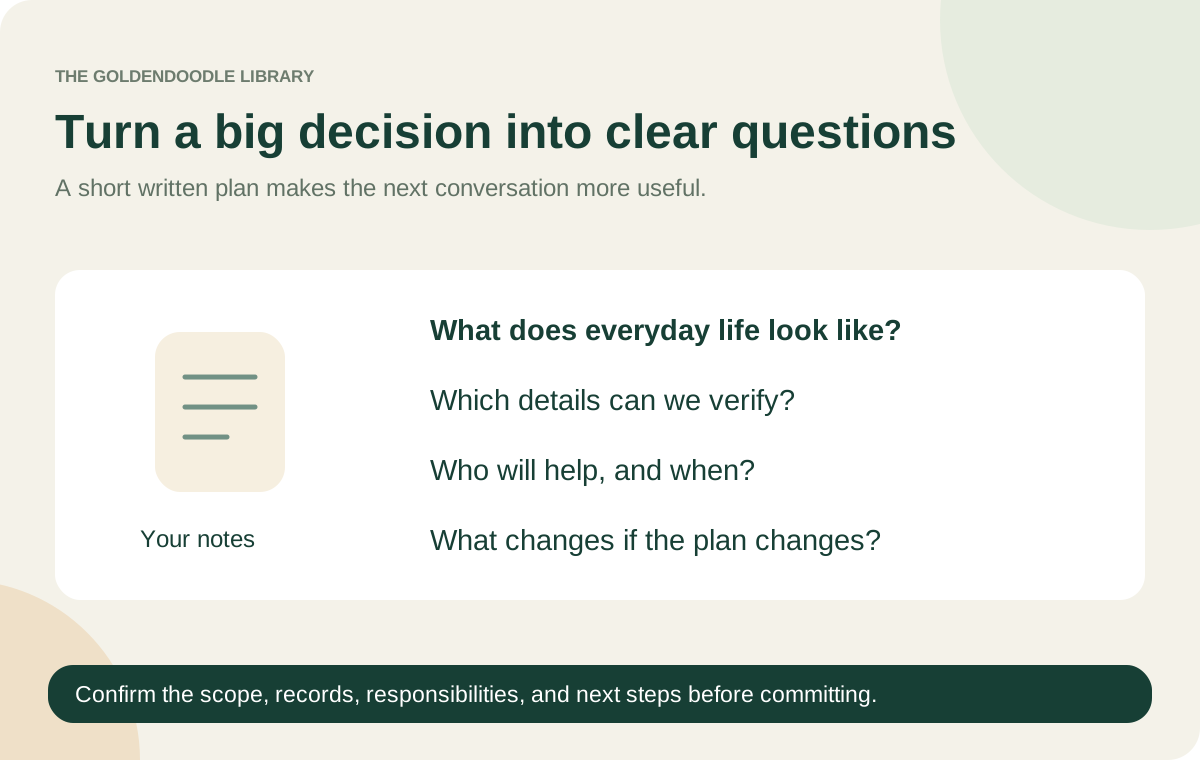
What to remember
Your useful takeaways.
- Connect the proposed support to specific outcomes in the person’s Individual Program Plan.
- Distinguish the individual budget from the spending plan and item-level decisions.
- Ask for written guidance before committing money or assuming reimbursement.
- Discuss providers, documentation, ongoing costs, and what happens if the candidate is unsuitable.
A little more detail
Explore the questions that matter to you.
Open a section when you want the why behind the short answer.
01Understand the planning framework
DDS describes SDP as offering eligible participants greater choice and responsibility in arranging services and supports that meet IPP objectives. DHCS explains that the program operates within an approved Medicaid waiver framework. Flexibility therefore exists within program requirements; it does not mean every requested purchase is automatically eligible.
Start by asking your Regional Center how to arrange a discussion about the proposed support and which current materials apply. If the person is not enrolled, ask about the enrollment process separately from the proposed dog-related expense. These are different decisions, and neither should be assumed from a conversation with a seller.
02Describe the individual need before the purchase
Prepare a plain-language account of the daily difficulty, the desired outcome, and the proposed role of a trained dog. Explain where the support would be used, who would handle the dog, and how it would work alongside current services. Identify what you know and what still needs professional assessment.
Ask the team what information it needs to evaluate that proposal. Keep puppy selection, suitability assessment, task training, handler education, and ongoing care as separate topics. This helps everyone discuss the actual components instead of treating service dog as a single undefined item. Include a plan for how progress would be reviewed and how an alternative would be considered if the original idea is not appropriate.
03Separate the budget from the spending plan
DDS distinguishes the amount available in an individual budget from the spending plan describing the services and items to be purchased. Its FAQ explains that a spending plan is connected to the IPP and reviewed against applicable service and funding requirements. Ask how those requirements would apply to each proposed dog-related component.
Request written answers about the proposed provider’s qualifications, documentation, payment process, and any limits or exclusions. Ask the Financial Management Services provider how an approved expense would actually be paid. Do not assume that approval of one component authorizes other purchases, later training, or every ongoing expense associated with the dog.
04Leave the meeting with a record of next steps
Bring a list of questions and keep a written record of decisions, unresolved issues, required documents, and the person responsible for the next step. Ask for the current official rule, service definition, or written determination behind an answer you do not understand. Current DDS resources should take priority over a general example on a breeder’s website.
Before signing a purchase or training agreement, confirm how the funding decision and the seller’s terms interact. Consider what happens if approval is delayed, a provider is not accepted, the dog is not suitable, or the proposed support changes. Clarifying those possibilities early lets the family plan without turning a hoped-for funding route into an unexpected personal obligation.
- Which IPP outcome would this proposed support address?
- What assessment or supporting documentation is needed?
- Which components are being considered separately?
- What provider requirements and payment procedures apply?
- Must approval be in writing before any commitment or purchase?
- How would a change of candidate, training plan, or role be handled?
Sources & further reading
References supporting this guide; inclusion does not imply endorsement of our program.
- California DDS: Self-Determination Program ↗
- California DHCS: Self Determination Program ↗
- California DDS: SDP Frequently Asked Questions ↗
- California DDS: SDP Resources and Tools ↗
For an individual dog’s health or behavior, consult your veterinarian or qualified trainer. For access or funding questions, check current official guidance.
A personal next step
Talk it through with Blaine.
Ask about a planned pairing, puppy matching, or preparing for home.