
The short version
Three things to keep in mind.
- 01
Ask what service-line means in this program.
- 02
Separate ancestry from observed and trained skills.
- 03
Put follow-up and change-of-plan options in writing.
What to remember
Your useful takeaways.
- Ask the breeder to explain exactly what service-line means in its program.
- Separate documented ancestry, observed behavior, health information, and trained skills.
- Consider the household and intended work when discussing a puppy match.
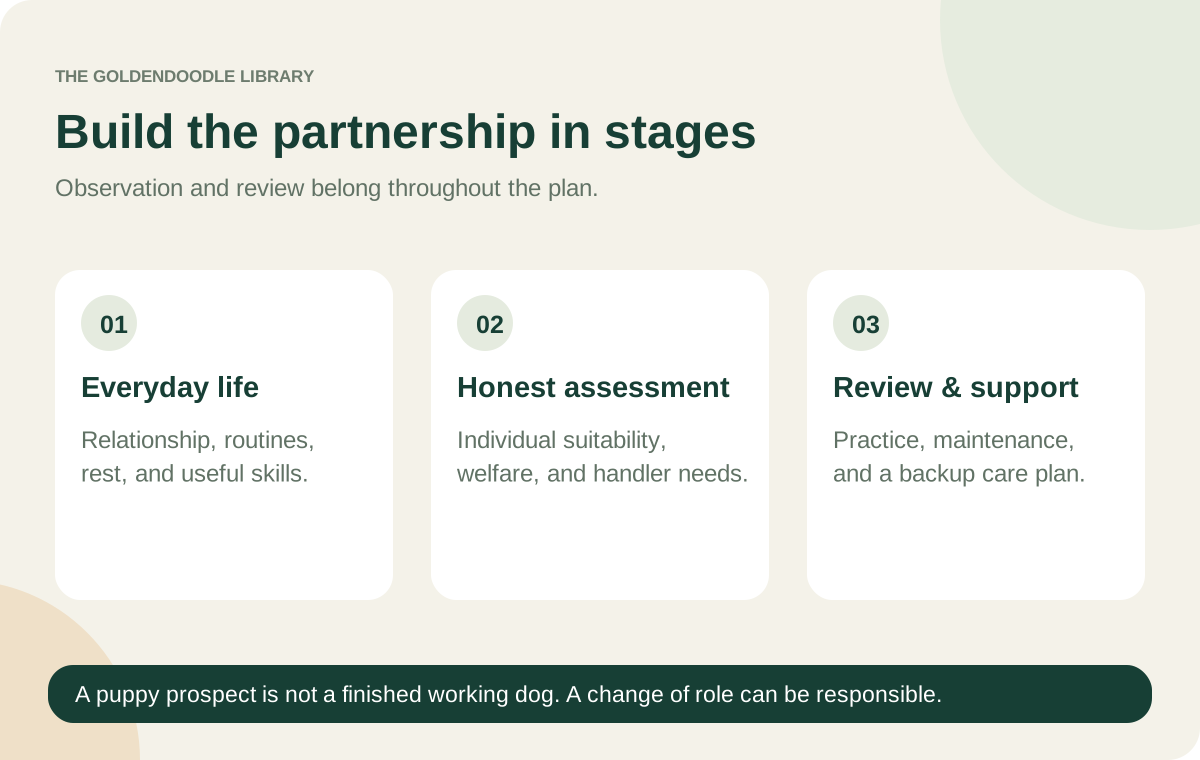
- A change of career can be a responsible outcome, not a failure of the dog.
A little more detail
Explore the questions that matter to you.
Open a section when you want the why behind the short answer.
01Ask for the story behind the label
Discuss the parents and relevant relatives individually. What roles did they actually perform? What records are available? Which observations come from the breeder, which come from a trainer, and which are owner reports? A clear answer distinguishes known history from a future aspiration.
Ask the same questions about health information and early care. A pedigree, health screen, socialization plan, and training record answer different questions. They are most helpful when discussed together, rather than presented as interchangeable proof that a particular dog must succeed. Keep copies of the information you receive and note where additional documentation is still needed.
02Look at the individual and the intended life
Consider what the family’s ordinary environment requires: recovery after a surprise, comfort around routine equipment, attention to a handler, ability to rest, and willingness to learn. Discuss these qualities with an assessor who understands the intended work. A pleasant visit or a quiet moment in the breeder’s home is one observation, not a full picture of adult behavior.
Describe your own setting honestly. A busy household, frequent appointments, young children, long absences, or a limited grooming budget can all change which match makes sense. A puppy should not be selected solely because its appearance is appealing or because a generation label sounds more advanced.
03Expect assessment to continue
Guide Dogs for the Blind explains that some dogs change careers because guide work requires a particular combination of health, skills, and behavior. This is a useful example from an established working-dog program: careful breeding and substantial support do not remove the need to evaluate individuals.
Agree on checkpoints with your trainer and veterinarian. Keep notes about the dog’s comfort, learning progress, recovery, and health, and discuss patterns rather than isolated successes. If the work repeatedly creates distress or the intended tasks do not suit the dog, reassess the goal. A different role may preserve a rewarding relationship without forcing the original plan.
References: [1]
04Put expectations into the agreement
Before committing, ask what the purchase arrangement does and does not include. Is there a separate trainer? Who evaluates suitability, what follow-up is offered, and how are concerns handled? A health guarantee is not automatically a guarantee of working success, and lifetime breeder support is not necessarily unlimited professional training.
Write down the family’s acceptable alternatives. Would you keep the dog as a companion if it is not suitable for service work? Would a different placement be considered, and under what agreement? These are practical matching questions worth resolving while everyone can think calmly. Honest expectations are a stronger foundation than a promise that no individual can reliably make.
- Meaning of service-line in this particular program.
- Available ancestry, health, and training evidence.
- Professional assessment plan and review points.
- Specific scope of breeder and trainer follow-up.
- Agreed options if the original working goal changes.
Sources & further reading
References supporting this guide; inclusion does not imply endorsement of our program.
For an individual dog’s health or behavior, consult your veterinarian or qualified trainer. For access or funding questions, check current official guidance.
A personal next step
Talk it through with Blaine.
Ask about a planned pairing, puppy matching, or preparing for home.