
The short version
Three things to keep in mind.
- 01
Map one everyday routine.
- 02
Ask what a dog would actually be trained to do.
- 03
Plan consent, adult handling, and backup care.
What to remember
Your useful takeaways.
- Describe the disability-related difficulty before proposing a dog task.
- Consider the individual’s preferences, communication, sensory comfort, and consent.
- Separate trained tasks from companionship and hoped-for benefits.
- Plan adult handling, backup care, and safety without relying solely on the dog.
A little more detail
Explore the questions that matter to you.
Open a section when you want the why behind the short answer.
01Map one ordinary day
Choose a familiar day and list the transitions that are genuinely difficult. Include getting ready, moving between places, managing belongings, communicating with caregivers, and settling at home. Note which supports already help, which gaps remain, and which situations require a person or an established safety system.
Make the list specific enough to discuss. For example, retrieving a dropped item is a clearer starting point than increasing independence. The latter is a goal; the former is an action that a professional can evaluate. It is equally useful to discover that a particular goal is better met by equipment, environmental changes, or human assistance.
02Turn the goal into a professional assessment
Canine Companions identifies autism, Down syndrome, and cerebral palsy among examples of disabilities served by its own program. It describes practical assistance such as retrieving items and operating certain switches or doors. These examples illustrate the need to connect a dog’s learned action to a person’s routine; they do not establish that every person needs the same task.
For a planning meeting, describe the proposed task’s trigger, action, benefit, and limitations. Ask the trainer which skills are prerequisites, how the person will communicate with the dog, and how success will be assessed. Do not attempt weight-bearing, restraint, or other physically demanding work on a growing puppy based on a general article.
References: [1]
03Design the partnership around all its members
The intended partner’s experience matters. Consider whether barking, movement, licking, fur, grooming sounds, or unexpected contact would make the household harder to navigate. Introductions should allow distance and choice; affection should never be forced to satisfy someone else’s idea of bonding.
A child’s partnership may also involve an adult facilitator. Discuss who gives cues, who supervises, and how responsibilities change at school, appointments, or family outings. Plan for days when the intended partner wants space, the dog is resting, or the regular caregiver is unavailable. A written handoff is often more useful than assuming everyone will handle the dog consistently.
References: [1]
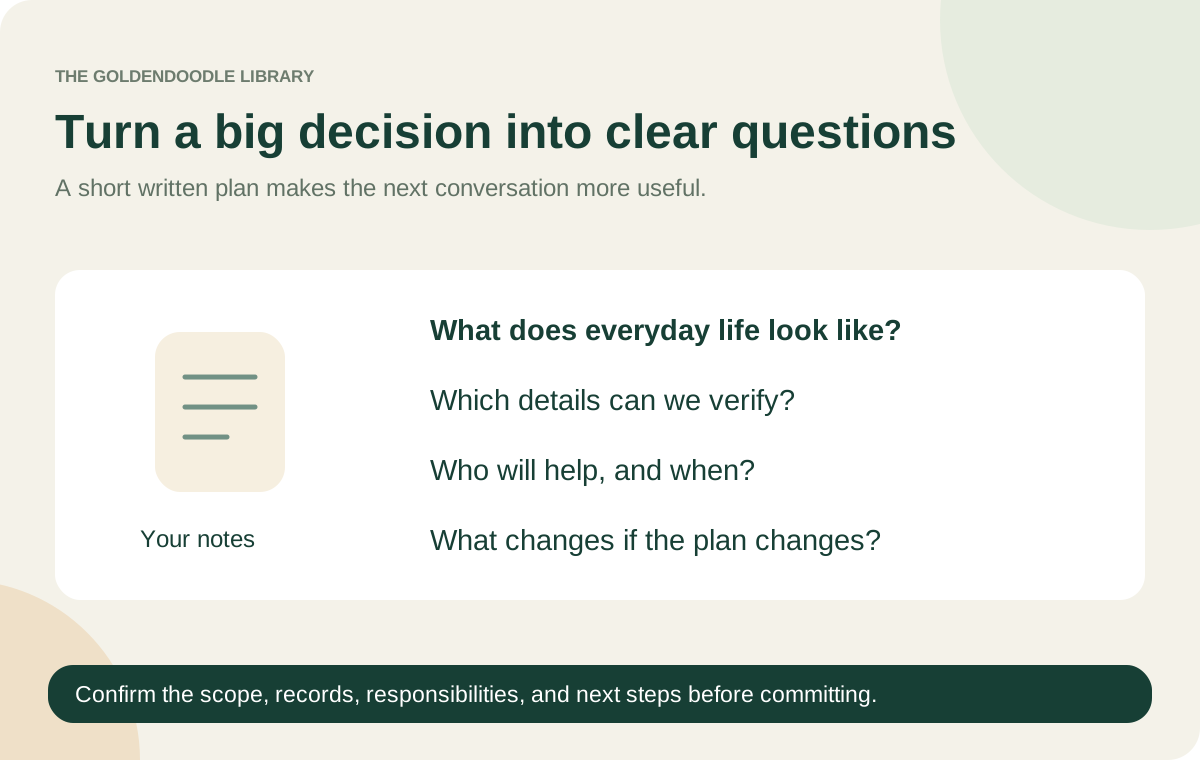
04Bring a clear planning sheet to the conversation
Prepare a short worksheet with the daily difficulty, the proposed action, the expected benefit, the places where it would be used, and the people involved. Add a separate column for what will happen if the dog does not perform the action. That last column keeps existing safety supports visible.
Review the sheet with the relevant care professional and a qualified service-dog trainer before choosing a candidate. Then ask the breeder how its matching process relates to those goals. Pedigree and early temperament observations can inform the conversation, but the final plan must remain responsive to the individual person and the individual dog.
- Routine: What happens, where, and with whom?
- Action: What would the dog actually be trained to do?
- Fit: Does the person want and tolerate that interaction?
- Backup: What support remains in place if the dog is unavailable?
- Review: Who will assess progress and change the plan?
Sources & further reading
References supporting this guide; inclusion does not imply endorsement of our program.
For an individual dog’s health or behavior, consult your veterinarian or qualified trainer. For access or funding questions, check current official guidance.
A personal next step
Talk it through with Blaine.
Ask about a planned pairing, puppy matching, or preparing for home.