The short version
Three things to keep in mind.
- 01
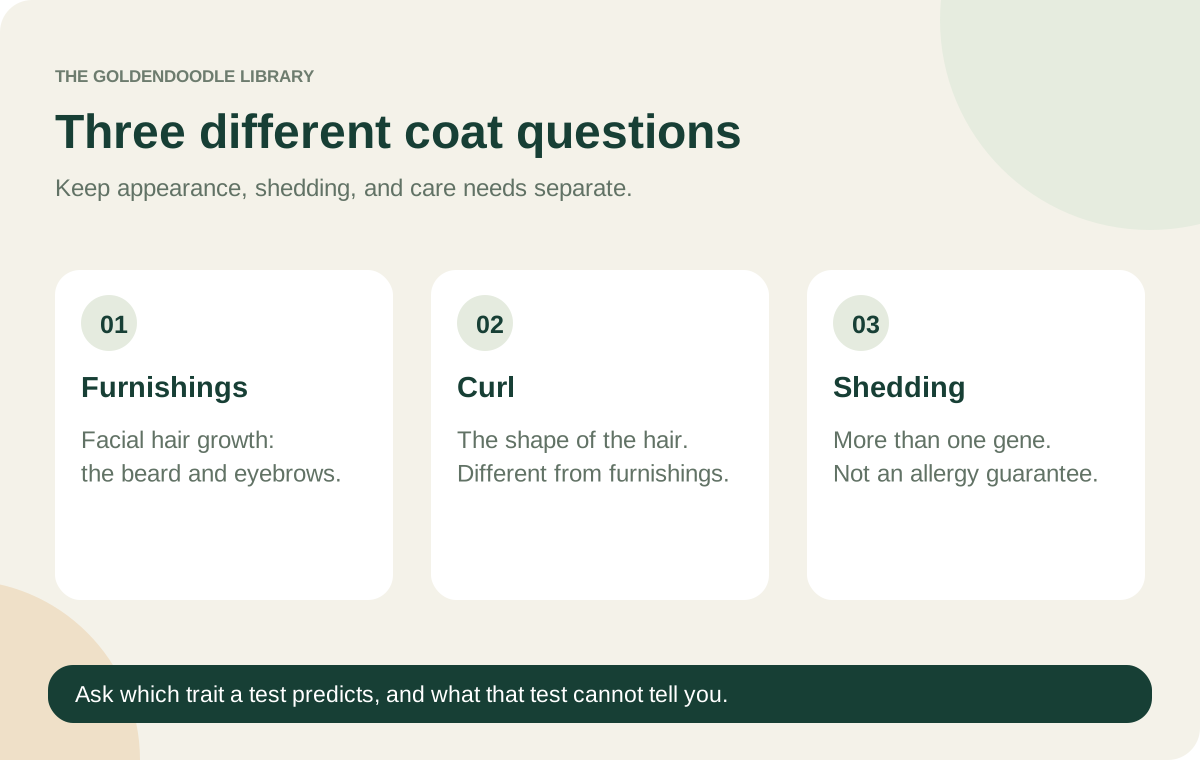
Separate facial furnishings from curl.
- 02
Ask whose test result you are seeing.
- 03
Plan care for the coat your dog actually has.
What to remember
Your useful takeaways.
- Facial furnishings and coat curl are different traits.
- Shedding is influenced by more than one gene.
- A coat test is not a guarantee of a particular adult haircut or allergy tolerance.
- Plan for coat care based on the individual dog, not only the generation label.
A little more detail
Explore the questions that matter to you.
Open a section when you want the why behind the short answer.
01Furnishings describe facial growth
UC Davis explains that a variant near RSPO2 is associated with the longer facial hair called furnishings, including beard and eyebrow growth. “Improper coat” is a terminology used in certain breeding contexts for the unfurnished pattern; it is not a statement about the dog’s worth as a companion.
Ask whether a result refers to the parent or to the puppy, and which laboratory performed the test. A photograph of a fluffy face is not the same document as an identified genetic report. Likewise, a puppy without the expected facial look still deserves a clear explanation and an appropriate home, rather than a misleading coat description.
References: [1]
02Curl is a separate question
The UC Davis curl test identifies relevant variants in KRT71. This is separate from testing for furnishings. A dog can have facial furnishings without the tight curl a visitor expects, so “furnished” and “curly” should not be used as interchangeable promises.
For a family deciding between litters, the practical question is not which coat label sounds most desirable. Ask what the results suggest, what has been seen in adult relatives, and how much uncertainty remains. Keep the difference between a genetic prediction and an observation of the finished adult coat clear.
References: [2]
03Less shedding is not zero shedding
UC Davis describes shedding as a complex trait and discusses the combined influence of MC5R and RSPO2. Relevant results can improve a breeding conversation, but they do not turn a living dog into a guaranteed hair-free household.
Separate your goals into a short list. One family may mainly want less loose hair on furniture; another may be worried about a diagnosed allergy; a third may be trying to budget for grooming. Do not accept one broad “non-shedding” claim as the answer to all three concerns.
References: [3]
04What this means for choosing and caring for a puppy
Ask for a realistic coat-care conversation before choosing a puppy. Discuss home handling, brushing and combing skills, the sort of haircut you can maintain, access to a groomer, and what changes might be noticed as the puppy grows. Your goal is a comfortable dog and a routine the household can sustain.
A precise question is more useful than asking for “the best coat.” For example: “We can commit to regular home grooming, but we need help learning how to check the coat properly. What would you expect for this puppy, and what would make you revise that expectation?” This invites practical guidance instead of a sales adjective.
05A simple checklist for coat claims
Keep copies of the relevant reports and ask the breeder to interpret them in plain language. Laboratory terms should help you understand the puppy, not make it harder to ask questions. If the explanation relies only on a generation label, return to the specific trait you wanted to understand.
- Which exact trait is being discussed?
- Whose result is this: parent, relative, or puppy?
- What does the laboratory say the result predicts?
- What does it not predict?
- How will the family manage coat care if the adult appearance differs from the estimate?
Sources & further reading
References supporting this guide; inclusion does not imply endorsement of our program.
- UC Davis Veterinary Genetics Laboratory: Furnishings and improper coat ↗
- UC Davis Veterinary Genetics Laboratory: Curl (C1, C2) ↗
- UC Davis Veterinary Genetics Laboratory: Shedding+ ↗
For an individual dog’s health or behavior, consult your veterinarian or qualified trainer. For access or funding questions, check current official guidance.
A personal next step
Talk it through with Blaine.
Ask about a planned pairing, puppy matching, or preparing for home.