The short version
Three things to keep in mind.
- 01
Name each parent before calculating.
- 02
Average the expected ancestry of both parents.
- 03
Ask what the breeder means by F2B.
What to remember
Your useful takeaways.
- Nominal ancestry is calculated by averaging each parent’s expected ancestry.
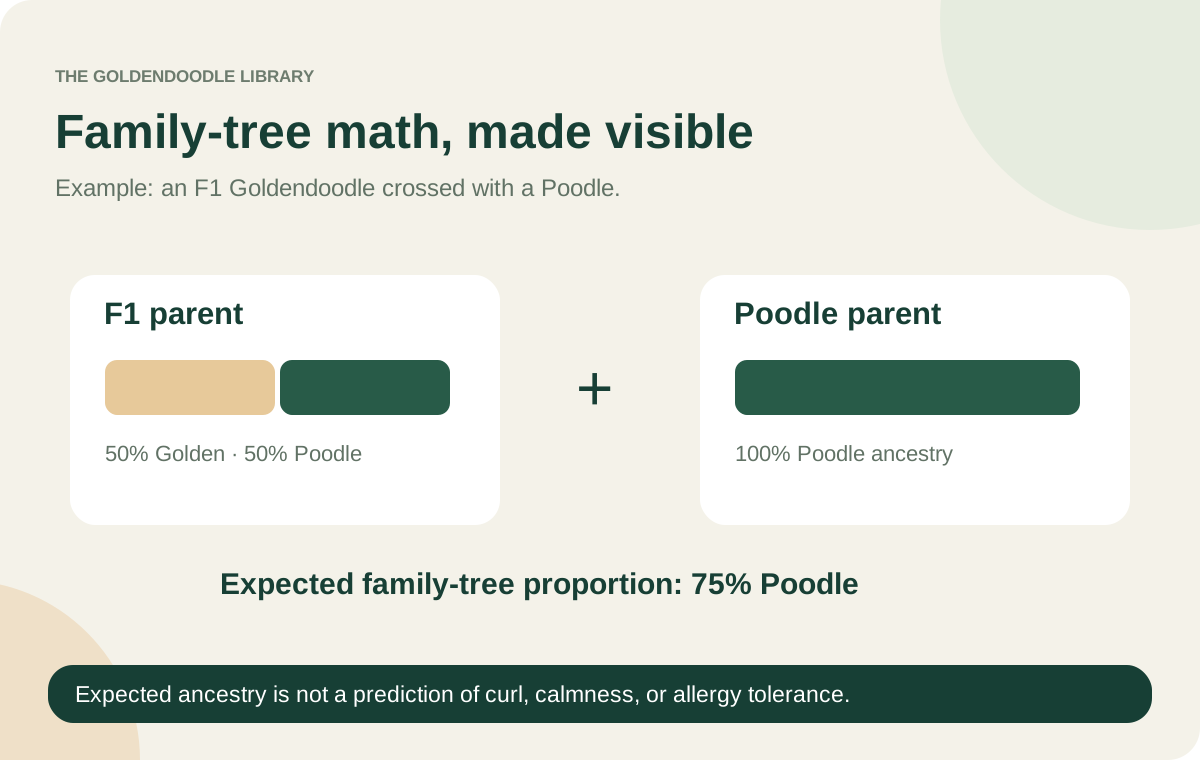
- F1 × Poodle gives an expected family-tree proportion of 75% Poodle.
- An F2B label can be used for crosses with different nominal proportions.
- Percent Poodle does not equal percent curl, percent calmness, or allergy safety.
A little more detail
Explore the questions that matter to you.
Open a section when you want the why behind the short answer.
01Start with a transparent calculation
For these examples only, assign a Golden Retriever 0% nominal Poodle ancestry and a Poodle 100%. Average the two parents to describe the expected family-tree proportion in the offspring. Golden Retriever × Poodle therefore gives (0 + 100) ÷ 2 = 50% nominal Poodle ancestry.
This is a bookkeeping model of ancestry. It is not a way to score a dog. A result of 75% does not mean three quarters of the dog’s coat, intelligence, health, or working potential comes from one side. Traits are influenced by particular inherited variants and other factors, rather than being poured together in matching percentages.
02Worked examples: write the parents before the label
GANA’s generation guide supports the basic distinction between a first cross, a backcross, and subsequent Goldendoodle generations. Later shorthand needs additional explanation. The arithmetic here is our own illustrative application of the stated family trees, not a DNA result for any dog.
| Stated cross | Nominal Poodle calculation | Expected family-tree proportion |
|---|---|---|
| Golden Retriever × Poodle | (0 + 100) ÷ 2 | 50% Poodle / 50% Golden Retriever |
| F1 × Poodle | (50 + 100) ÷ 2 | 75% Poodle / 25% Golden Retriever |
| F1 × Golden Retriever | (50 + 0) ÷ 2 | 25% Poodle / 75% Golden Retriever |
| F1B-to-Poodle × Poodle | (75 + 100) ÷ 2 | 87.5% Poodle / 12.5% Golden Retriever |
| F1 × F1 | (50 + 50) ÷ 2 | 50% Poodle / 50% Golden Retriever |
| F2 (F1 × F1) × Poodle | (50 + 100) ÷ 2 | 75% Poodle / 25% Golden Retriever |
| F1 × F1B-to-Poodle | (50 + 75) ÷ 2 | 62.5% Poodle / 37.5% Golden Retriever |
References: [1]
03Why F2B is a question, not a complete answer
You may encounter an F2 × Poodle cross described as F2B, while another naming chart applies F2B to F1 × F1B. Those two stated parentages produce different nominal figures in the table. There is no benefit in arguing over the abbreviation while leaving the actual family tree unexplained.
Ask the breeder which convention they use and record both parents’ ancestry. If the answer is only “F2B means better,” return to the question. The important information is the cross, the individual dogs selected, the records behind them, and the reasons for the pairing.
04Why nominal ancestry does not predict the whole puppy
Traits such as furnishings, curl, and shedding have their own genetic information. A parent can pass different combinations to different puppies. Asking about relevant coat results therefore answers a different question from asking about the generation label.
For a practical comparison, imagine two planned litters with the same nominal Poodle proportion. One has documented parent coat results and information about adult relatives; the other has only a percentage claim. The identical arithmetic does not make those evidence packages equal. Use ancestry to understand the family tree, then evaluate the puppy and the supporting records separately.
Sources & further reading
References supporting this guide; inclusion does not imply endorsement of our program.
- Goldendoodle Association of North America: Goldendoodle generations ↗
- UC Davis Veterinary Genetics Laboratory: Furnishings and improper coat ↗
- UC Davis Veterinary Genetics Laboratory: Curl (C1, C2) ↗
For an individual dog’s health or behavior, consult your veterinarian or qualified trainer. For access or funding questions, check current official guidance.
A personal next step
Talk it through with Blaine.
Ask about a planned pairing, puppy matching, or preparing for home.