The short version
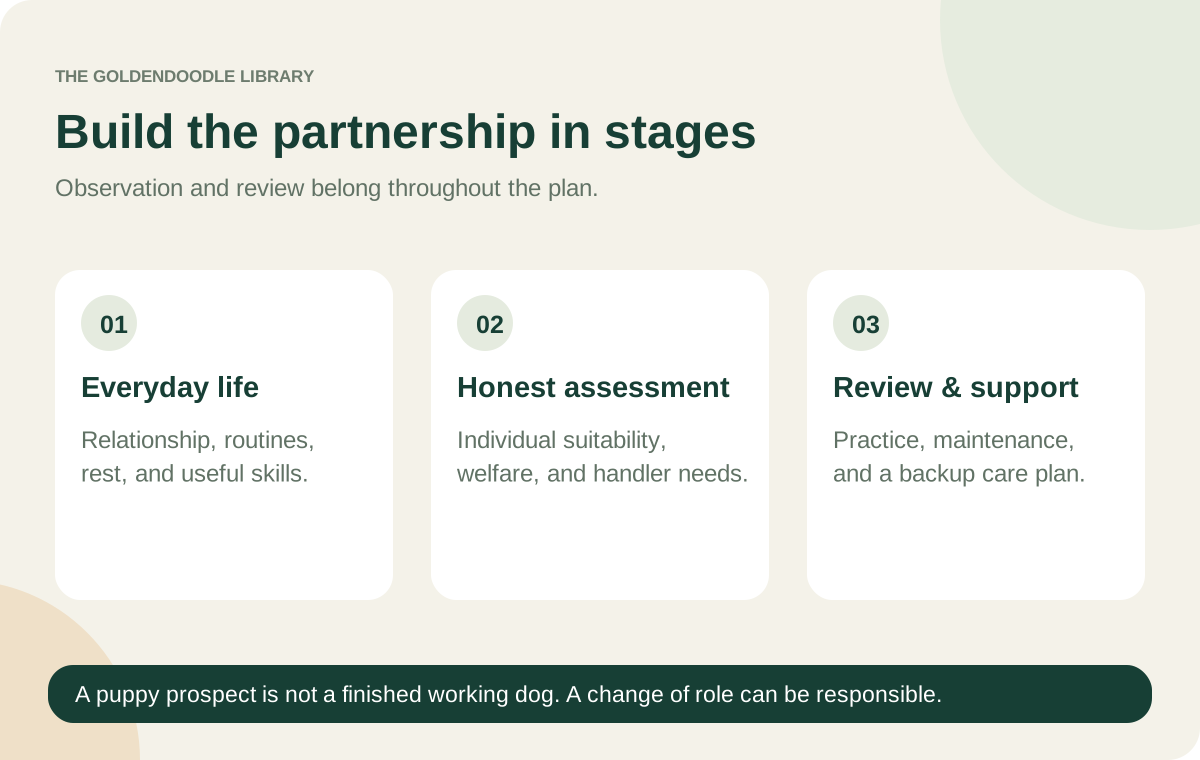
Three things to keep in mind.
- 01
Build calm routines and a secure relationship.
- 02
Use honest professional checkpoints.
- 03
Plan ongoing maintenance and a possible new role.
What to remember
Your useful takeaways.
- Start with everyday life skills and a secure relationship.
- Use professional checkpoints to decide whether the working goal remains suitable.
- Task performance and public behavior need separate attention.
- Plan for maintenance, follow-up, and a possible change of role.
A little more detail
Explore the questions that matter to you.
Open a section when you want the why behind the short answer.
01Stage one: build an everyday partnership
The first training plan should fit a young dog’s actual life: settling at home, comfortable handling, toilet routines, short learning sessions, and manageable experiences in appropriate places. Discuss the puppy’s health and exposure plan with your veterinarian and trainer instead of copying someone else’s schedule.
Keep a small training journal. Record the skill, setting, assistance needed, and how the dog appeared to feel. A note such as rested calmly for three minutes while the family ate is more useful than a broad label such as perfect temperament. The journal helps the trainer choose the next achievable step and notice when the plan is asking too much.
02Stage two: review the prospect honestly
Set review meetings before adding complexity. Talk about the dog’s health, ability to recover after ordinary surprises, attention, comfort around the intended environment, and the family’s capacity to continue. The purpose is to make a decision, not to prove that the original choice was correct.
Established programs also reassess dogs. Guide Dogs for the Blind describes career-change pathways for dogs not continuing in its guide role, including consideration of other suitable work or companion homes. Families can adopt the same basic principle of flexibility without assuming another organization’s process or outcome applies to their own dog.
References: [1]
03Stage three: connect useful actions to real routines
Work with the trainer to define each proposed task, its trigger, its completion, and the environment in which it will matter. Teach manageable pieces and document how assistance is reduced. One successful demonstration in a quiet room is a reason to continue evaluating, not a reason to skip the remaining preparation.
The person handling the dog needs practice too. Plan cue consistency, reward delivery, recognizing fatigue, managing equipment, and responding when the dog cannot work. ADI’s description of its standards emphasizes education and training for both sides of an assistance-dog partnership. Its program standards are a useful reference, not a substitute for the applicable law.
References: [2]
04Stage four: maintain the team and its support
A working plan should include follow-up sessions, veterinary coordination, rest, routine care, and a person to contact when a trained behavior changes. Record which tasks are dependable, which are still being developed, and what support must remain in place. This avoids treating graduation, however a program defines it, as the end of learning.
Under the ADA, owner-training is permitted; there is no requirement to use a professional program. That legal distinction does not remove the practical value of experienced assessment. Compare professional options early, understand what you can realistically deliver yourself, and seek help when the task or behavior falls outside your competence.
- Set goals that can be observed rather than guessed.
- Review welfare and suitability before increasing difficulty.
- Include handler education and backup support.
- Keep a maintenance plan after the initial training phase.
References: [3]
Sources & further reading
References supporting this guide; inclusion does not imply endorsement of our program.
- Guide Dogs for the Blind: Career Change Dogs ↗
- Assistance Dogs International: Summary of Standards ↗
- U.S. Department of Justice: Service Animal FAQs ↗
For an individual dog’s health or behavior, consult your veterinarian or qualified trainer. For access or funding questions, check current official guidance.
A personal next step
Talk it through with Blaine.
Ask about a planned pairing, puppy matching, or preparing for home.